AI Visibility Audit:Find What AI SearchEngines Cannot See.
VektorAI analyzes over 100 SEO, AEO, and GEO signals on any URL — showing you exactly what stops ChatGPT, Perplexity, and Google AI Overviews from citing your content.
◈ The shift
AEO and GEO: Optimizing for the AI Answer Layer
In 2025, generative AI platforms such as ChatGPT, Perplexity, and Google AI Overviews became primary information sources for millions of users. Unlike traditional SEO — which focuses primarily on keyword placement and backlinks — AEO and GEO optimize the structured signals and content quality that AI engines require before they will cite a page. According to generative engine optimization research, pages with complete structured data and strong E-E-A-T signals are significantly more likely to appear in AI-generated answer panels. For example, a page with a complete FAQPage schema and a direct-answer opening paragraph consistently outperforms unstructured content in AI citation frequency.
AEO — Answer Engine Optimization
AEO targets visibility in AI-generated answers by ensuring your page has the right machine-readable signals: JSON-LD schemas, Open Graph tags, Twitter Cards, AI bot access in robots.txt, and a structured llms.txt file. Without these, AI engines cannot reliably identify or trust your page.
GEO — Generative Engine Optimization
GEO goes deeper — it optimizes the content itself to be selected and quoted by generative AI. This means strong E-E-A-T signals (author credentials, editorial review), highly quotable paragraphs, authority citations, content comprehensiveness (800+ words), and query-aligned titles and headings.
"According to a 2025 Schema.org adoption study by W3Techs, only 22% of websites implement JSON-LD structured data — leaving 78% without the markup that AI engines rely on for citation and answer generation."
— W3Techs Web Technology Surveys, 2025
AEO gets you indexed. GEO gets you cited. VektorAI audits both — compared to checking signals manually, our automated audit covers 100+ rules in under 30 seconds.
◈ What we audit
What Does VektorAI Audit on Your Page?
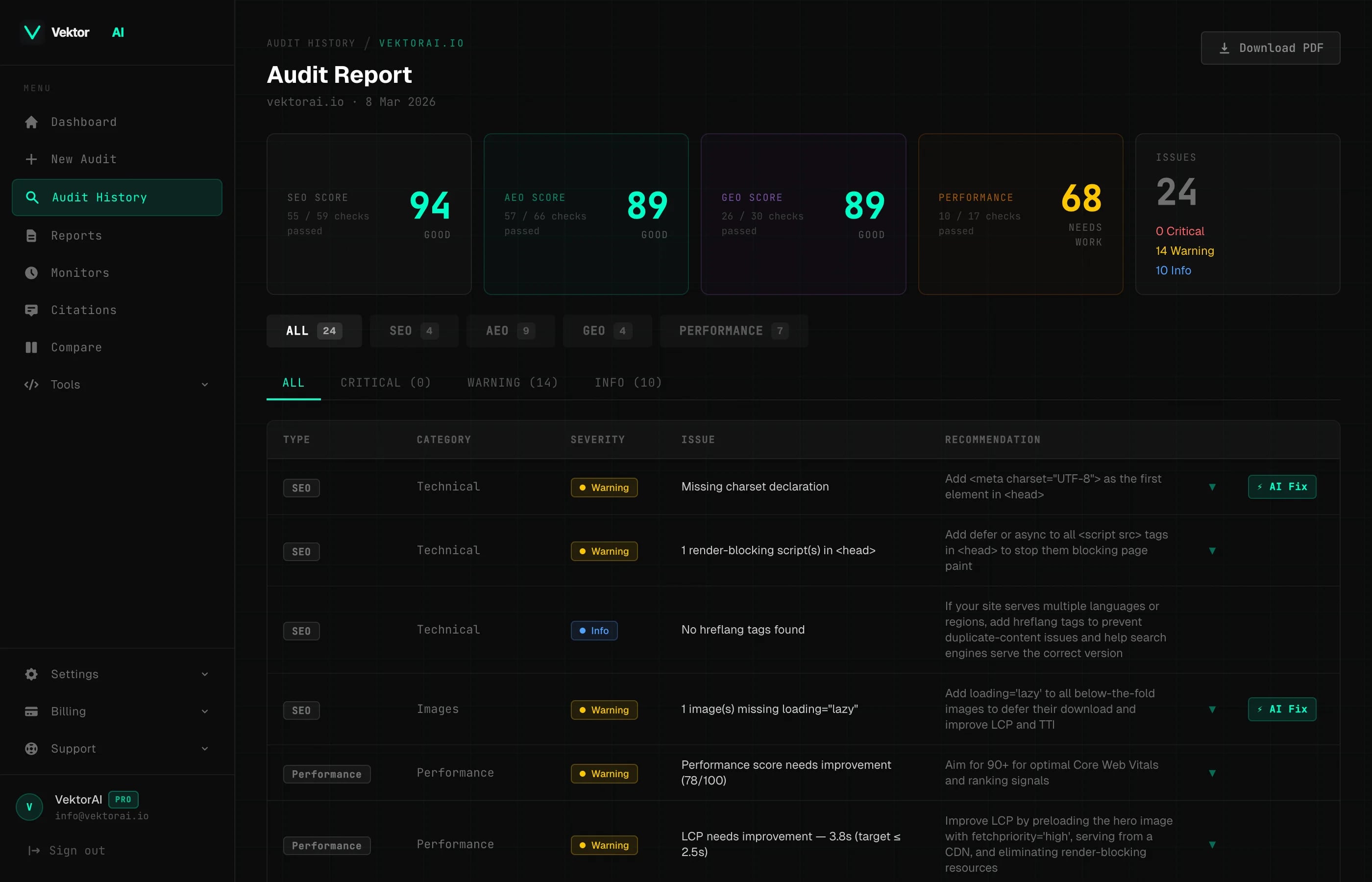
VektorAI analyzes 100+ signals across four scored categories — SEO, AEO, GEO, and Performance. Each check is weighted by severity: Critical (3 pts), Warning (2 pts), or Info (1 pt) — producing a 0–100 score per category.
SEO
SEO Checks
On-page signals for search engine crawlability and rankings.
- ✓Title tag length (30–60 chars)
- ✓Meta description (100–160 chars)
- ✓Canonical URL, viewport, charset
- ✓H1 presence and heading hierarchy
- ✓Image alt text, dimensions, lazy load
- ✓Internal and external link quality
- ✓Sitemap.xml and robots.txt directive
- ✓Content depth (300+ visible words)
- ✓Breadcrumb navigation
AEO
AEO Checks
Structured metadata for AI engine understanding and citation.
- ✓Open Graph: title, description, image, type
- ✓Twitter Cards: card, title, description
- ✓FAQPage schema with 3+ Q&A pairs
- ✓Organization schema with sameAs
- ✓Article schema with author, datePublished
- ✓BreadcrumbList and WebSite schemas
- ✓Author signals: byline, meta author
- ✓AI bot access in robots.txt
- ✓llms.txt structure and links
GEO
GEO Checks
Content quality signals for generative AI selection and citation.
- ✓E-E-A-T: About, Contact, Privacy links
- ✓Author bio, credentials, editorial review
- ✓Direct-answer opening paragraph (≤60 words)
- ✓Featured snippet candidate (40–60 words)
- ✓TL;DR / Key Takeaways section
- ✓Statistics, data points, blockquotes
- ✓Authority external links (.gov, .edu)
- ✓Content depth (800+ words, comparisons)
- ✓Intent title, FAQ, question headings
Performance
Performance Checks
Core Web Vitals and load speed via Google PageSpeed Insights.
- ✓Overall PageSpeed score (target 90+)
- ✓LCP — Largest Contentful Paint (2.5s)
- ✓CLS — Cumulative Layout Shift (0.1)
- ✓TBT — Total Blocking Time (200ms)
- ✓FCP — First Contentful Paint (1.8s)
- ✓TTFB — Server response time (600ms)
- ✓TTI — Time to Interactive (3.8s)
- ✓Unused JavaScript and CSS detection
- ✓Image format and cache policy
◈ The problem
Why Are AI Search Engines Ignoring Your Content?
AI search engines such as ChatGPT Search, Perplexity, and Google AI Overviews do not guess. When they cannot find the right structured signals on your page, they move to a competitor page that has them. Every missing tag is a missed citation.
The five most common reasons AI engines skip your content:
- ✕Missing JSON-LD schemas
Without FAQPage, Organization, or Article schemas, AI engines have no machine-readable context to cite from.
- ✕AI bots blocked in robots.txt
Disallowing GPTBot, ClaudeBot, or Google-Extended prevents AI indexing entirely, regardless of content quality.
- ✕No llms.txt file
AI crawlers cannot efficiently discover your key pages without a structured llms.txt at your domain root.
- ✕Incomplete Open Graph tags
Missing og:title or og:description causes AI crawlers to fabricate summaries — often inaccurately — rather than cite you.
- ✕Weak E-E-A-T and content signals
No author credentials, thin content under 800 words, no statistics, and no direct-answer paragraph — generative AI skips content it cannot confidently quote.
Learn more: Google structured data guide · FAQPage schema reference
<head>
  <meta charset="UTF-8">
  <meta name="viewport" ...>

  <!-- ✕ <title> missing -->
  <!-- ✕ og:title missing -->
  <!-- ✕ og:description missing -->
  <!-- ✕ No JSON-LD schema -->

  <meta name="description"
    content="Short."
    {/* ⚠ only 6 chars */}
  >
  <!-- ✓ canonical present -->
</head>
◈ How it works
How Does the AI Visibility Audit Work?
The audit fetches your page server-side, runs all 100+ checks in under 30 seconds, and returns a scored, actionable report — no account or installation required.
Enter your URL
Paste any public page URL. VektorAI fetches and parses the full HTML source — every meta tag, every JSON-LD block, every attribute.
Analysis runs automatically
Over 100 checks analyze every SEO signal, AEO structured data tag, GEO content quality signal (E-E-A-T, quotability, citations), and PageSpeed vital.
Review your scored report
Get scored across SEO, AEO, GEO, and Performance — free, no account needed. Unlock the full report to see every issue with severity, explanation, and a copy-paste fix. Pro users also get AI-powered suggestions tailored to their content.

Ready to start? Run a free audit on any URL — no account needed.
◈ AI fix suggestions
From Diagnosis to Fix — Instantly.
VektorAI doesn't just tell you what's wrong. For applicable issues, it generates a ready-to-use fix tailored to your page's actual content — cutting hours of manual research and implementation down to seconds.
Meta Tags & Open Graph
Rewrites your meta description, title tag, or Open Graph fields using your page's headings, content summary, and context — ready to copy and paste into your HTML.
JSON-LD Schema Blocks
Generates complete FAQPage, Organization, Article, or BreadcrumbList schema blocks pre-filled with your page data — paste directly into your <head> and be indexable by AI engines.
GEO Content Improvements
Drafts a featured snippet paragraph, TL;DR section, FAQ entries, question headings, or an author biography — content crafted around your page topic to boost AI citability.
Context-Aware, Not Generic
Every suggestion is built from your page's actual title, headings, existing description, and content — not a one-size-fits-all template that reads like a machine wrote it.
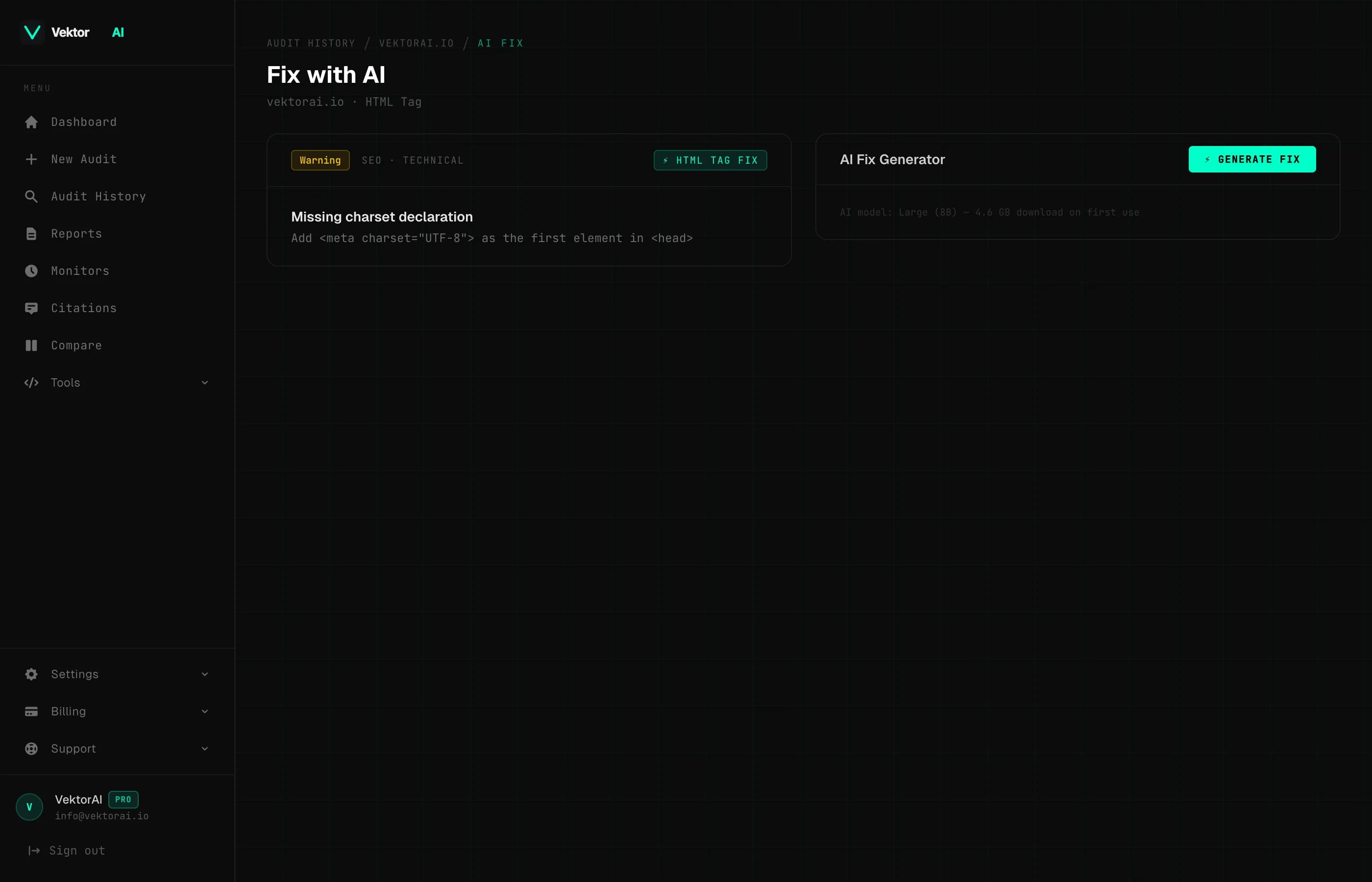
AI fix suggestions are available on saved audits.
Sign in to save your audit history and get one-click AI suggestions for every applicable issue — across meta tags, schemas, and GEO content.
◈ Scheduled monitors
Automated Audits. Score Alerts.
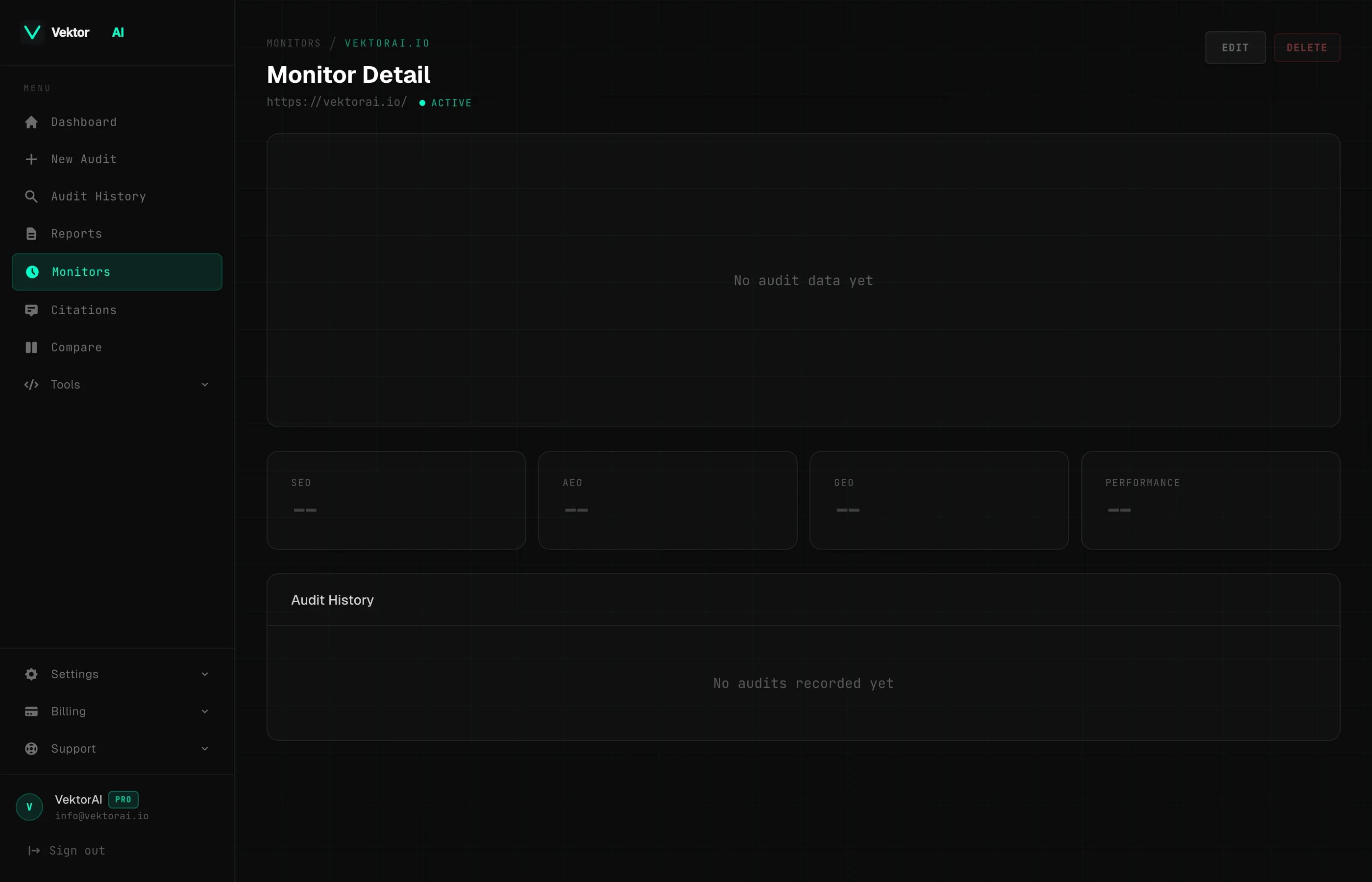
Stop manually re-running audits. Set up a monitor and VektorAI automatically audits your site weekly or monthly — tracking score trends over time and alerting you when something drops.
Set & forget
Choose weekly or monthly. VektorAI runs the audit automatically and saves every result to your trend history.
Score trend charts
Interactive line charts show SEO, AEO, GEO, and Performance over time with delta arrows on each pillar.
Email alerts
Set a threshold. If any score drops below it, you get an email immediately — before your users notice.
◈ FAQ
Frequently Asked Questions
What is AEO (Answer Engine Optimization)?
▶
AEO is the practice of optimizing web content so that AI-powered search engines like ChatGPT, Perplexity, and Google AI Overviews can accurately understand, extract, and cite your content. It covers structured data markup (JSON-LD), Open Graph tags, Twitter Cards, AI bot access rules in robots.txt, and llms.txt — all signals that help machines read and trust your pages.
What is GEO (Generative Engine Optimization)?
▶
GEO optimizes your content to be selected and quoted by generative AI when composing answers. While AEO handles metadata signals, GEO focuses on content quality: E-E-A-T trust (author credentials, editorial review), quotability (direct-answer paragraphs, statistics, TL;DR sections), citation depth (authority links, attribution phrases), content comprehensiveness (800+ words, examples), and query alignment (intent-matching titles, FAQ sections, question headings).
How does VektorAI audit my page for AI visibility?
▶
VektorAI fetches your page server-side and analyzes over 100 signals across four categories: SEO (title, meta, headings, images, links), AEO (Open Graph, JSON-LD schemas, robots.txt, llms.txt), GEO (E-E-A-T signals, content quotability, citation depth, content depth, query alignment), and Performance (Core Web Vitals via Google PageSpeed Insights). Your SEO, AEO, GEO, and Performance scores are free with no account needed. Unlock the full report (one-time $9) to see every issue with copy-paste code fixes, or go Pro for unlimited audits and AI-powered suggestions.
Why is my content not appearing in AI search answers?
▶
The most common causes are: missing JSON-LD schemas (FAQPage, Organization), incomplete Open Graph tags, AI bots blocked in robots.txt (GPTBot, ClaudeBot), a missing llms.txt file, thin content under 300 words, no author credentials or E-E-A-T signals, and an opening paragraph that does not directly answer the user query. VektorAI identifies all of these with specific fixes for each.
What is llms.txt and why does it matter?
▶
llms.txt is a plain-text file at your website root that helps AI crawlers understand your site structure and key pages. A well-structured llms.txt with a title, section headers, and markdown links significantly improves your content discoverability by AI systems. VektorAI checks whether it exists, has an H1 title, section headers, links, and sufficient word count.
What SEO, AEO, and GEO checks does VektorAI perform?
▶
VektorAI performs over 100 checks. SEO: title length, meta description, canonical, viewport, heading hierarchy, image alt/WebP, link quality, sitemap, content depth. AEO: full Open Graph set, Twitter Cards, JSON-LD schemas (FAQPage, Organization, Article, BreadcrumbList, WebSite), author signals, AI bot access, llms.txt. GEO: About/Contact/Privacy links, author bio and credentials, editorial review, featured snippet paragraphs, TL;DR sections, statistics, authority external links, attribution phrases, content depth (800+ words), comparison content, intent-matching titles, FAQ sections, question subheadings. Performance: LCP, CLS, TBT, FCP, TTFB, TTI via PageSpeed Insights.
Does VektorAI provide AI-powered fix suggestions?
▶
Yes. For applicable issues, VektorAI generates contextual fix suggestions built from your page's actual content. This includes rewritten meta descriptions and title tags, complete JSON-LD schema blocks (FAQPage, Organization, Article), Open Graph rewrites, featured snippet paragraphs, TL;DR sections, FAQ entries, question-style headings, and author biography templates. Every suggestion uses your page's own title, headings, and content as context — not a generic template. AI fix suggestions are available when you sign in and access your saved audit history.
◈ Free. No account.
Audit Your Page for Free — No Account Needed.
Takes under 30 seconds. No signup required. Get your SEO, AEO, GEO, and Performance scores instantly — then unlock the full report to see every issue with copy-paste fixes.
Already know what you need? View full report pricing or learn about VektorAI.