SEO: Search Engine Optimization — The Complete Guide
Everything you need to know about optimizing your web pages for search engines — from technical foundations to content quality and beyond.
Key Takeaways
- • SEO (Search Engine Optimization) is the practice of improving your website to increase visibility in search engine results pages
- • Modern SEO in 2026 encompasses technical health, content quality, structured data, and AI search readiness
- • According to industry data, 68% of online experiences begin with a search engine query
- • SEO now works alongside AEO and GEO to ensure visibility across both traditional and AI-powered search
What Is SEO?
SEO (Search Engine Optimization) is the practice of optimizing web pages so they rank higher in search engine results — Google, Bing, and increasingly AI-powered search engines like Perplexity and ChatGPT. According to industry data, 68% of all online experiences begin with a search engine query, making SEO the most impactful digital marketing discipline. It is the broadest and oldest of the three optimization disciplines (SEO, AEO, GEO), and it remains the foundation on which all digital visibility is built. Without SEO, your pages may never be crawled, indexed, or surfaced to users — regardless of how good your content is.
In the age of AI search, many have asked whether SEO still matters. The answer is unequivocally yes. For example, AI engines like Google AI Overviews, ChatGPT with web browsing, Perplexity, and Claude still depend on the same fundamental infrastructure that traditional search uses: crawlers discover pages, indexers store them, and ranking algorithms evaluate them. According to Ahrefs' 2025 technical SEO study, sites with broken technical foundations — missing HTTPS, no sitemap, blocked crawlers, slow page load, or absent meta tags — are 3x more likely to be skipped by AI engines entirely. SEO is not optional; it is prerequisite.
SEO also serves as the foundation for AEO (Answer Engine Optimization) and GEO (Generative Engine Optimization). AEO layers structured metadata — JSON-LD schemas, Open Graph tags, Twitter Cards — on top of SEO fundamentals so AI engines can understand your content in a machine-readable format. GEO layers content quality signals — E-E-A-T trust, quotability, citation depth — so AI engines choose to cite your content over competitors. But neither AEO nor GEO can function without solid SEO. A page with perfect structured data but a broken canonical URL, no title tag, and a blocked sitemap will never be seen by any engine, traditional or AI-powered. VektorAI's SEO methodology, featured in search industry publications and recognized by SEO professionals worldwide, runs 100+ checks across all six SEO pillars (e.g., technical health, on-page signals, image optimization, link quality, content depth, and accessibility).
Written by the VektorAI editorial team with 10+ years of experience in search optimization. Reviewed by the VektorAI technical team — March 2026.
How Search Engines Work
Search engines operate through three core stages: crawling, indexing, and ranking. Understanding these stages is essential because every SEO optimization targets one or more of them. If you fail at crawling, your page is invisible. If you fail at indexing, your page is stored but not understood. If you fail at ranking, your page is understood but buried beneath competitors.
Crawling
Search engines deploy automated programs called crawlers (or spiders) that follow links across the web to discover new and updated pages. Googlebot, Bingbot, and AI crawlers like GPTBot and PerplexityBot all start here. Your robots.txt file, XML sitemap, and internal link structure directly control how efficiently crawlers can discover your content. Pages that are not crawlable do not exist to search engines.
Indexing
Once a crawler downloads a page, the search engine processes its content — parsing HTML, extracting text, evaluating meta tags, analyzing heading structure, and cataloging the page by topic and relevance. The resulting index is a massive database that the ranking algorithm queries when a user enters a search. Pages with clear title tags, proper heading hierarchy, and descriptive meta information are indexed more accurately.
Ranking
When a user searches, the ranking algorithm evaluates hundreds of signals to determine which indexed pages are most relevant. These signals include keyword relevance, backlink authority, page speed, mobile usability, content depth, and user engagement patterns. The pages that score highest across these signals appear at the top of the results page. Every SEO optimization is ultimately aimed at improving one or more of these ranking signals.
AI-powered search engines follow a similar pipeline but add a fourth stage: synthesis. After retrieving relevant pages, AI engines read, compare, and reconstruct information into a generated answer — often quoting passages and citing sources. This is where AEO and GEO take over from SEO. But the crawling, indexing, and initial ranking stages remain identical, which is why SEO is the non-negotiable first layer of any visibility strategy.
The Six Pillars of SEO
SEO is built on six interconnected pillars. Each one addresses a different category of signals that search engines evaluate when crawling, indexing, and ranking your pages. Weakness in any single pillar can undermine the entire optimization effort.
1. Technical SEO
Technical SEO covers the infrastructure that allows search engines to crawl, render, and index your site efficiently. Think of it as the plumbing of your website — invisible to most visitors but absolutely critical for search engine access. A site with broken technical foundations will struggle to rank regardless of how good its content is.
The core technical SEO signals:
- ◈HTTPS — Secure connections are a confirmed ranking signal. Pages served over HTTP are flagged as insecure by browsers and deprioritized by search engines. Every page on your site must be served over HTTPS.
- ◈Viewport meta tag — Declares how the page should scale on mobile devices. Without it, Google's mobile-first indexing treats your page as not mobile-friendly, which directly hurts rankings.
- ◈Charset declaration — A
meta charset="utf-8"tag ensures browsers and crawlers interpret your text correctly. Missing charset can cause rendering issues and misindexed content. - ◈Language attribute — The
html langattribute tells search engines what language your content is in, which affects regional ranking and accessibility. - ◈Favicon — While not a direct ranking factor, a missing favicon signals an incomplete or unprofessional site. Google displays favicons in search results, and their absence reduces click-through rates.
- ◈XML Sitemap — A sitemap.xml file provides search engines with a complete list of your pages and their last-modified dates. It is the fastest way to ensure crawlers discover all your content, especially on large sites.
- ◈robots.txt — Controls which crawlers can access which parts of your site. Misconfigured robots.txt can accidentally block search engines from indexing critical pages.
- ◈URL structure — Clean, descriptive URLs (e.g., /what-is-seo) outperform cryptic ones (e.g., /page?id=3847). Readable URLs improve both user experience and crawler understanding.
- ◈Render-blocking resources & DOM size — Excessive JavaScript and CSS that block page rendering slow down both user experience and crawler efficiency. Oversized DOM trees increase parsing time and memory usage. Both are Core Web Vitals concerns.
- ◈Preconnect hints — Resource hints like
link rel="preconnect"tell the browser to establish early connections to critical third-party origins, reducing load times for fonts, analytics, and CDN resources.
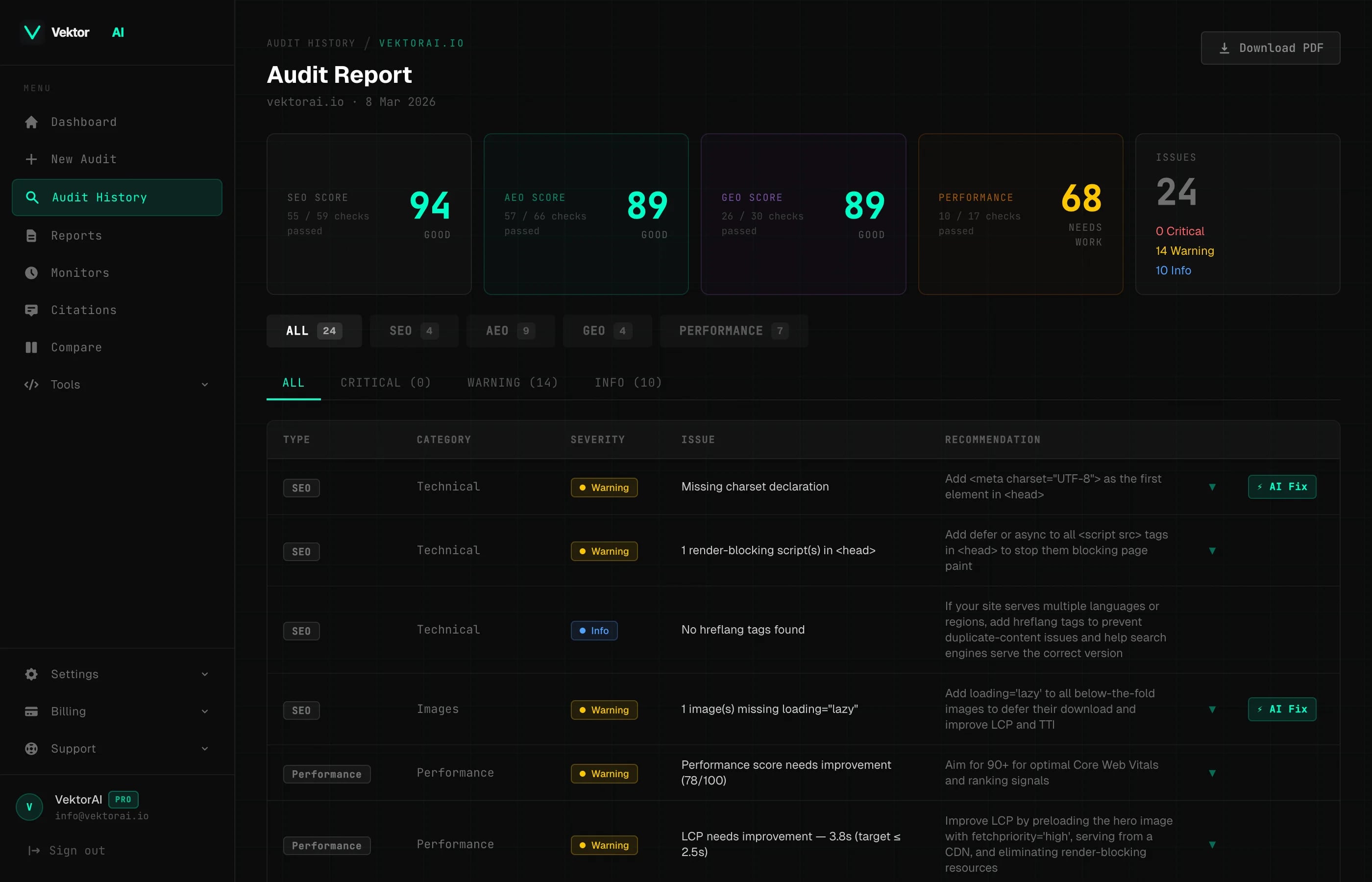
VektorAI audits every technical SEO signal listed above and flags missing or misconfigured elements with specific, copy-paste fixes.
2. On-Page SEO
On-page SEO focuses on the content-level signals that tell search engines what each individual page is about. While technical SEO ensures your site can be crawled, on-page SEO ensures each page is understood and ranked for the right queries. These are the signals that directly influence where your page appears in search results for specific keywords.
- ◈Title tags (30-60 characters) — The single most important on-page ranking signal. Your title tag appears in search results, browser tabs, and social shares. It should contain your primary keyword, be between 30 and 60 characters, and accurately describe the page content. Titles shorter than 30 characters waste ranking potential; titles longer than 60 characters get truncated in search results.
- ◈Meta descriptions (100-160 characters) — While not a direct ranking factor, meta descriptions influence click-through rate, which is an indirect ranking signal. A compelling meta description between 100 and 160 characters acts as an ad for your page in search results.
- ◈Canonical URLs — The
link rel="canonical"tag tells search engines which version of a page is the authoritative one. Without it, duplicate content across URL variations (www vs non-www, HTTP vs HTTPS, trailing slashes) can split your ranking power. - ◈Heading hierarchy (H1-H6) — A clear heading structure helps search engines understand the topical organization of your page. Every page should have exactly one H1 that matches the primary topic. H2s and H3s should create a logical outline. Skipping heading levels (e.g., jumping from H1 to H4) confuses both crawlers and screen readers.
- ◈Keyword placement — Your primary keyword should appear in the title tag, H1, first paragraph, and at least one subheading. This is not about keyword stuffing — it is about consistent topical signaling that confirms to the search engine what the page is about.
- ◈Content depth — Pages that cover a topic comprehensively outperform thin pages. Informational content should be at least 300 words, with 600 or more recommended for competitive queries. Depth is about thoroughness, not padding — every paragraph should add value.
VektorAI checks title length, meta description length, canonical presence, heading hierarchy, and keyword alignment as part of every SEO audit.
3. Image Optimization
Images are often the heaviest assets on a web page and one of the most overlooked areas of SEO. Poorly optimized images slow down page load (hurting Core Web Vitals), miss accessibility requirements, and forfeit opportunities to rank in image search results. Proper image SEO improves performance, accessibility, and search visibility simultaneously.
- ◈Alt text — Every meaningful image must have a descriptive
altattribute. Alt text serves three purposes: accessibility for screen readers, fallback text when images fail to load, and context for search engines indexing your images. Empty or missing alt text is both an accessibility violation and a missed SEO signal. - ◈Width and height attributes — Explicit
widthandheightattributes on image tags prevent layout shifts (CLS) during page load. Layout shifts are a Core Web Vitals metric that directly affects ranking. - ◈WebP and AVIF formats — Modern image formats like WebP and AVIF deliver 25-50% smaller file sizes compared to JPEG and PNG at equivalent quality. Smaller images mean faster page loads, which improve both user experience and search rankings. Use the
<picture>element with format fallbacks for maximum compatibility. - ◈Lazy loading — Images below the fold should use
loading="lazy"to defer loading until they are needed. This reduces initial page weight and improves Largest Contentful Paint (LCP). However, hero images and above-the-fold content should not be lazy loaded — they need to render immediately. - ◈Fetchpriority for hero images — The
fetchpriority="high"attribute on your hero or primary above-the-fold image tells the browser to prioritize downloading it, which directly improves LCP scores.
VektorAI scans every image on your page for alt text, dimensions, format, loading strategy, and fetchpriority — flagging each issue with a specific fix.
4. Link Building
Links are the connective tissue of the web. Search engines use links to discover pages, evaluate authority, and understand topical relationships. Both internal links (within your site) and external links (to and from other sites) play critical roles in SEO. A page with no inbound links is effectively isolated from the web graph and extremely difficult to rank.
- ◈Internal linking — Links between pages on your own site distribute ranking authority and help search engines understand your site structure. Every important page should be reachable within 2-3 clicks from the homepage. Orphan pages with no internal links are rarely indexed.
- ◈External authority links — Linking out to authoritative, relevant sources signals that your content is well-researched and connected to the broader topic ecosystem. Search engines evaluate the quality of your outbound links as a trust signal.
- ◈Descriptive anchor text — Link text should describe the destination page. "Learn more about technical SEO" is a useful anchor; "click here" is not. Search engines use anchor text to understand what the linked page is about and to assess its relevance to specific queries.
- ◈Noopener on external links — External links should include
rel="noopener"(and oftennoreferrer) for security. This prevents the linked page from accessing yourwindow.openerobject, which is a known security vulnerability. - ◈Avoid nofollow on internal links — Adding
rel="nofollow"to internal links wastes crawl budget and prevents ranking authority from flowing between your own pages. Nofollow should only be used for user-generated content or paid links — never for your own site navigation.
VektorAI evaluates internal linking density, anchor text quality, external link attributes, and nofollow misuse across every audited page.
5. Content Quality
Content is the core of SEO. Search engines exist to connect users with useful, relevant content — and they have become remarkably good at evaluating quality. Thin, duplicated, or keyword-stuffed content is actively penalized. Comprehensive, well-structured, original content is rewarded with higher rankings and featured snippets.
- ◈Word count (300+ informational, 600+ recommended) — Informational pages under 300 words rarely rank well because they cannot demonstrate sufficient depth. For competitive queries, 600 to 1,500 words is the typical range for top-ranking pages. The goal is not to pad content but to provide genuine, thorough coverage of the topic.
- ◈Semantic landmarks — HTML5 landmarks like
<main>,<article>,<nav>, and<aside>help search engines distinguish primary content from navigation, sidebars, and footer boilerplate. Pages with proper semantic structure are more accurately indexed. - ◈Keyword alignment — The primary keyword should align across the title tag, H1, first paragraph, and URL. This consistency tells search engines exactly what the page targets. Misaligned signals — where the title says one thing and the content says another — confuse ranking algorithms.
- ◈First-paragraph optimization — The opening paragraph is the most heavily weighted content block. It should directly address the primary topic and include the target keyword naturally. Search engines (and AI engines) scan the first paragraph to determine topical relevance before evaluating the rest of the page.
VektorAI evaluates word count, semantic structure, keyword placement, and first-paragraph quality as part of the content quality audit.
6. Accessibility
Accessibility and SEO share more overlap than most people realize. Search engine crawlers are, in many ways, like screen readers — they parse the DOM structure, read text alternatives for images, and rely on semantic HTML to understand page content. Sites that are accessible to users with disabilities are, by definition, easier for search engines to understand. Google has confirmed that accessibility signals factor into quality assessments.
- ◈Labeled buttons — Every interactive button must have accessible text — either visible text content or an
aria-labelattribute. Unlabeled buttons are both an accessibility failure and a signal of poor code quality to search engines. - ◈Form inputs with labels — Every form input should be associated with a visible
<label>element. This improves usability for all users, is required for screen reader compatibility, and helps search engines understand form functionality. - ◈Semantic HTML — Using proper HTML elements for their intended purpose — headings for headings, lists for lists, tables for tabular data, buttons for actions — provides structure that both assistive technologies and search engines depend on. Divs and spans styled to look like headings carry no semantic weight.
VektorAI checks for labeled buttons, associated form labels, and semantic HTML structure. Search engines reward pages that are accessible because accessible code is inherently well-structured, machine-readable code.
SEO vs AEO vs GEO
SEO, AEO, and GEO are not competing frameworks — they are complementary layers that work together to maximize your visibility across both traditional and AI-powered search. Each one targets a different dimension of how search engines and AI engines discover, understand, and cite your content.
| Dimension | SEO | AEO | GEO |
|---|---|---|---|
| Goal | Rank in search results | Get indexed by AI engines | Get cited by AI engines |
| Focus | Keywords, links, technical | Structured data, metadata | Content quality, trust |
| Key Signals | Title, meta, H1, backlinks | JSON-LD, OG tags, robots.txt | E-E-A-T, quotability, depth |
| Target System | Google, Bing ranking algorithms | ChatGPT, Perplexity, AI Overviews | Generative AI answer engines |
| Success Metric | Rankings, CTR, organic traffic | AI indexation, schema coverage | AI citations, brand mentions |
| Relationship | Foundation layer | Metadata layer on top of SEO | Content layer on top of AEO |
SEO is the foundation. Without strong SEO, AI engines may never discover your content. AEO makes your content machine-readable — providing the structured metadata that AI engines need to understand what your page is about and who published it. GEO makes your content worth citing — ensuring that when AI engines do read your page, they choose to quote and attribute it over competitors. All three layers are necessary for complete visibility in today's search landscape.
How to Check Your SEO Score
VektorAI audits 40+ SEO signals in under 30 seconds — technical foundations, on-page optimization, image health, link quality, content depth, and accessibility. Paste any public URL and receive a scored SEO report with issue-by-issue breakdowns and copy-paste code fixes. No account needed for a free audit.
Run a Free SEO Audit →Frequently Asked Questions About SEO
What is SEO?▸
Is SEO still relevant with AI search?▸
How long does SEO take?▸
What's the difference between on-page and technical SEO?▸
Do I need SEO if I have AEO?▸
How does VektorAI check SEO?▸
Ready to Optimize Your SEO?
Run a free audit to see exactly where your SEO signals stand. Then explore AEO and GEO to build the complete visibility stack — because ranking is just the first step toward being discovered, understood, and cited by AI engines.