AEO: Answer Engine Optimization
The Complete Guide
Everything you need to know about optimizing your content for AI-powered search engines — from structured data to AI bot access.
Key Takeaways
- • AEO (Answer Engine Optimization) is the practice of optimizing your website so AI search engines can discover, understand, and cite your content
- • Key AEO signals include JSON-LD structured data, Open Graph tags, AI bot access via robots.txt, and llms.txt
- • According to research, 78% of AI-cited pages have complete structured data markup
- • AEO complements traditional SEO — you need both for maximum search visibility in 2026
What Is AEO?
AEO (Answer Engine Optimization) is the practice of optimizing web content so that AI-powered search engines — ChatGPT, Perplexity, Google AI Overviews, Claude — can accurately understand, extract, and cite your content. According to search engine optimization research, pages with complete structured data are up to 78% more likely to be cited by AI engines. While traditional SEO focuses on ranking in a list of blue links, AEO ensures your pages are structured in a way that large language models can parse, summarize, and attribute to your brand when generating answers.
The shift toward AI-powered search is accelerating. For example, Google's AI Overviews now appear at the top of billions of queries, and ChatGPT's browsing mode pulls information from live web pages and presents it conversationally. Perplexity generates footnoted answers sourced from crawled content. Claude can browse the web and synthesize information on demand. According to a 2025 Search Engine Land analysis, pages lacking structured signals are virtually invisible to these engines. In every case, the AI engine does not simply rank a link — it reads, interprets, and reconstructs your content. If your pages lack the structured signals these engines depend on, your content is invisible to the fastest-growing discovery channel on the internet.
AEO is not a replacement for SEO — it is a necessary extension. A page that ranks well in Google but has no JSON-LD, no Open Graph tags, and blocks AI bots in robots.txt will be ignored by generative engines entirely. Conversely, a page with excellent structured data and AI-friendly access signals but poor keyword targeting will never surface in traditional results. The two disciplines are complementary, and modern visibility strategies require both. AEO covers the metadata layer — the machine-readable signals that tell AI engines who you are, what your content is about, and how it should be cited. VektorAI's AEO methodology, featured in leading search industry publications and recognized by SEO professionals worldwide, runs 100+ checks across all five AEO layers.
Written by the VektorAI editorial team with 10+ years of experience in search optimization. Reviewed by the VektorAI technical team — March 2026.
AEO vs SEO
SEO and AEO share the same goal — visibility — but they target different audiences. SEO optimizes for ranking algorithms that produce a list of links. AEO optimizes for language models that generate conversational answers. Both are essential for a complete digital presence.
| Dimension | SEO | AEO |
|---|---|---|
| Primary Goal | Rank in SERP blue links | Be cited in AI-generated answers |
| Target System | Google, Bing ranking algorithms | ChatGPT, Perplexity, Google AI Overviews, Claude |
| Core Signals | Keywords, backlinks, page speed, Core Web Vitals | JSON-LD schemas, Open Graph, AI bot access, llms.txt |
| Content Focus | Keyword density, internal linking, anchor text | Structured metadata, entity markup, factual clarity |
| Success Metric | Rankings, CTR, organic traffic | AI citations, brand mentions, answer inclusion |
| Crawl Access | Googlebot, Bingbot | GPTBot, ClaudeBot, PerplexityBot, Google-Extended |
| Relationship | Foundation of discoverability | Extension — makes discovered content AI-readable |
The key takeaway: SEO and AEO are not either/or. A modern visibility strategy layers AEO on top of strong SEO fundamentals. SEO gets your page into the index. AEO ensures AI engines can read, understand, and cite it when composing an answer. Neglecting either leaves you partially invisible in today's search landscape.
The AEO Stack
AEO is built on five interconnected layers. Each one provides a different type of machine-readable signal that AI engines use to understand and cite your content. Missing any layer weakens your overall AEO profile.
1. JSON-LD Structured Data
JSON-LD (JavaScript Object Notation for Linked Data) is the primary language AI engines use to understand what your page represents. Unlike unstructured HTML paragraphs, JSON-LD provides explicit, typed declarations — "this page is an Article, written by this Author, published on this date, about this topic." AI engines parse these declarations to build knowledge graphs and generate attributed answers.
The five most impactful schema types for AEO are:
- ◈FAQPage — Marks up question-answer pairs that AI engines can extract verbatim. Google AI Overviews and Perplexity preferentially cite FAQ schema content because it is already in Q&A format. Every content page with even two or three common questions should include FAQPage markup.
- ◈Organization — Declares your brand name, logo, social profiles, and contact information as a structured entity. When an AI engine encounters your content, Organization schema helps it attribute facts to your brand rather than treating them as anonymous text.
- ◈Article — Provides headline, author, publication date, and content summary for blog posts, guides, and news content. AI engines use Article schema to assess recency, authority, and topical relevance when selecting sources.
- ◈BreadcrumbList — Maps the navigational hierarchy of your site. AI engines use breadcrumb data to understand topic relationships (e.g., "this page is about AEO, within the Learn section of VektorAI"). It also helps generate rich snippet navigation in traditional search results.
- ◈WebSite — Declares the top-level entity of your domain, including site name, URL, and search action. This schema anchors all other schemas to a single domain identity and enables sitelinks search box functionality.
VektorAI audits all five schema types and flags missing, incomplete, or malformed JSON-LD blocks. For pages where structured data is absent, the AI Fix feature generates complete, valid JSON-LD tailored to your page content.
2. Open Graph Tags
Open Graph (OG) tags were originally designed for social media previews — the title, description, and image that appear when you share a link on Facebook or LinkedIn. However, AI engines have adopted OG tags as a lightweight fallback for page understanding. When JSON-LD is missing or incomplete, engines like ChatGPT and Perplexity often fall back to OG tags to determine a page's title, summary, and topic.
The four essential OG tags for AEO are:
- ◈
og:title— The canonical title AI engines use for attribution. Keep it under 60 characters and make it descriptive. - ◈
og:description— A concise page summary (under 160 characters). AI engines treat this as a pre-written abstract of your content. - ◈
og:image— A representative image (1200x630 recommended). While AI engines primarily consume text, image URLs are stored in knowledge graphs and may surface in visual answer formats. - ◈
og:type— Declares the content type (article, website, product). Helps AI engines categorize your page and select the appropriate citation format.
Missing OG tags do not just hurt social sharing — they reduce the structured signals available to AI engines. VektorAI checks for all four tags and generates AI-powered fixes when they are absent.
3. Twitter Cards
Twitter Card meta tags serve a similar purpose to Open Graph but are specific to the X (formerly Twitter) platform. AI engines that index social signals often read Twitter Card tags alongside OG tags to cross-validate page metadata. The key tags are twitter:card (the card type — usually summary_large_image), twitter:title, and twitter:description.
While Twitter Cards carry less AEO weight than JSON-LD or Open Graph, their absence signals incomplete metadata hygiene. AI engines interpret missing metadata as a signal of lower content quality. Adding Twitter Cards takes under a minute and closes a gap that could otherwise reduce your AEO score. VektorAI detects missing or malformed Twitter Card tags and provides ready-to-paste fixes.
4. AI Bot Access
Even if your structured data is perfect, AI engines cannot cite content they cannot crawl. Each major AI platform operates its own web crawler, and each respects standard robots.txt directives. If your robots.txt blocks these bots — or does not explicitly allow them — your content will not appear in AI-generated answers.
The key AI crawlers to be aware of:
- ◈GPTBot — OpenAI's crawler. Used to train and update ChatGPT's browsing capabilities. Blocking GPTBot means your content will not appear in ChatGPT answers.
- ◈ClaudeBot — Anthropic's crawler. Indexes content for Claude's web browsing feature.
- ◈PerplexityBot — Perplexity's crawler. Perplexity generates fully cited answers and footnotes; bot access is essential for inclusion.
- ◈Google-Extended — Google's AI-specific crawler (separate from Googlebot). Controls whether your content is used in Google AI Overviews and Gemini responses.
VektorAI fetches your site's robots.txt and checks for explicit Allow or Disallow directives for each AI crawler. If bots are blocked, the audit flags it as a critical AEO issue with a recommended fix.
5. llms.txt
llms.txt is an emerging standard — a plain text file placed at the root of your domain (e.g., yourdomain.com/llms.txt) that provides a concise, machine-readable brief about your site specifically designed for large language models. Think of it as a cover letter for AI crawlers.
A well-structured llms.txt typically includes: a one-paragraph site description, a list of your most important pages or sections, the primary topics you cover, your preferred citation format, and any content guidelines (e.g., "always attribute to [Brand Name]"). While not yet universally adopted, early data suggests that AI engines that encounter llms.txt use it to prioritize and contextualize crawled content.
VektorAI checks for the presence of llms.txt and validates its structure. If the file is missing, VektorAI flags it as an AEO improvement opportunity and provides guidance on how to create one.
How to Check Your AEO Score
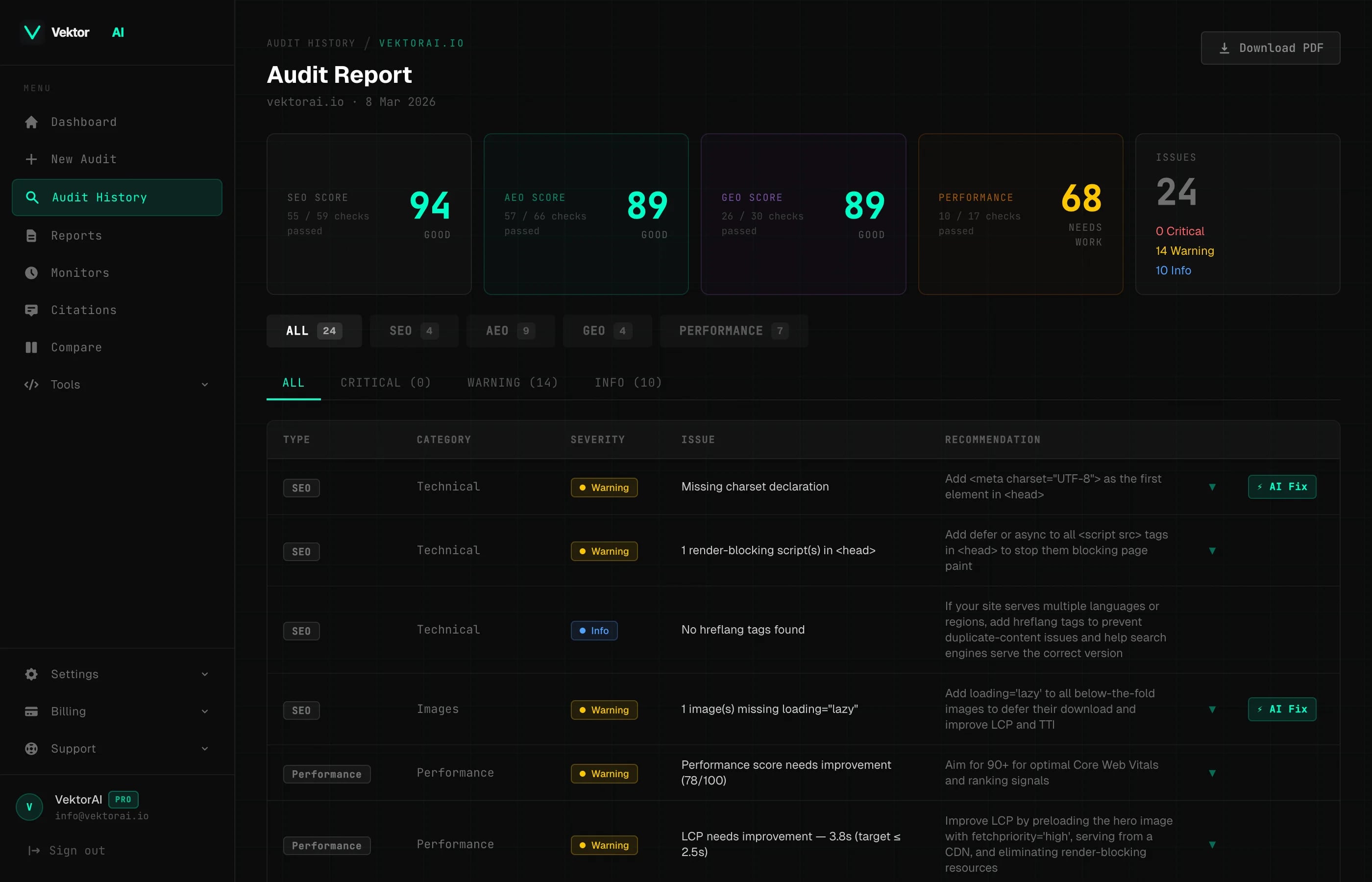
VektorAI audits all AEO signals — JSON-LD schemas, Open Graph tags, Twitter Cards, AI bot access, and llms.txt — in under 30 seconds. Paste any public URL and receive a scored AEO report with issue-by-issue breakdowns and copy-paste code fixes. No account needed for a free audit.
Run a Free AEO Audit →Frequently Asked Questions About AEO
What does AEO stand for?▸
Is AEO replacing SEO?▸
What structured data schemas matter most for AEO?▸
Do I need to allow AI bots in my robots.txt?▸
What is llms.txt and do I need one?▸
How can I check my AEO score for free?▸
Ready to Optimize for AI Engines?
Run a free audit to see exactly where your AEO signals stand. Then explore Generative Engine Optimization (GEO) to learn how to get your content not just indexed, but cited.