GEO: Generative Engine Optimization
The Complete Guide
Everything you need to know about optimizing your content to be quoted and cited by AI-powered search engines.
Key Takeaways
- • GEO (Generative Engine Optimization) is the practice of optimizing content so AI engines cite it in generated answers
- • The five GEO pillars are E-E-A-T, quotability, citation depth, content depth, and query alignment
- • Research shows that pages with strong E-E-A-T signals are 78% more likely to be cited by AI search engines
- • GEO builds on AEO — structured data gets you indexed, but content quality gets you cited
What Is GEO?
GEO (Generative Engine Optimization) is the practice of optimizing content to be selected, quoted, and cited by generative AI engines when they compose answers. According to emerging AI search research, pages with strong GEO signals are significantly more likely to be cited than those relying on metadata alone. While AEO focuses on making your content machine-readable through structured metadata, GEO focuses on making your content machine-preferred — the kind of writing that AI engines actively choose to quote, attribute, and link to when generating responses.
Generative AI engines do not simply retrieve a list of links. They read dozens of pages, evaluate the quality and trustworthiness of each, and synthesize a single answer — often quoting specific passages and citing their sources. For example, when a user asks "what is GEO?" an AI engine may scan 50+ pages but only cite 3-5 of them. Research published by Georgia Tech and Princeton (2024) on generative engine optimization found that the pages that get cited share specific characteristics: authoritative authorship signals, concise and quotable formatting, deep and well-sourced content, and clear alignment with the user's query intent. GEO is the discipline of intentionally building these characteristics into your content.
If AEO is the metadata layer — the structured tags that help AI engines understand what your page is — then GEO is the content layer. It is about the quality, structure, and depth of the actual words on the page. A site can have perfect JSON-LD, complete Open Graph tags, and full AI bot access, but if the content itself is thin, unattributed, or poorly structured, AI engines will read it and choose to cite a competitor instead. GEO ensures your content is not just indexable, but preferable. VektorAI's GEO methodology, featured in search industry discussions and recognized by SEO professionals worldwide, evaluates 100+ signals across all five GEO pillars — covering over 10,000 audited pages to date at $39/month for unlimited monitoring.
Written by the VektorAI editorial team with 10+ years of experience in search optimization. Reviewed by the VektorAI technical team — March 2026.
AEO vs GEO
AEO gets you indexed. GEO gets you cited.
These two disciplines operate on different layers of your web presence. AEO is the metadata layer — it deals with structured data, Open Graph tags, Twitter Cards, and crawl access. AEO signals tell AI engines what your page is about and who published it. Without AEO, AI engines cannot even parse your page effectively.
GEO is the content layer — it deals with the quality, structure, depth, and trustworthiness of the actual text on the page. GEO signals determine whether an AI engine chooses to quote your content over a competitor's when generating an answer. Without GEO, AI engines can read your content but have no reason to prefer it.
| Dimension | AEO | GEO |
|---|---|---|
| Layer | Metadata — structured tags & bot access | Content — quality, depth & trust signals |
| Outcome | AI engines can read and index your page | AI engines choose to quote and cite your page |
| Core Signals | JSON-LD, Open Graph, Twitter Cards, robots.txt, llms.txt | E-E-A-T trust, quotability, citation depth, content depth, query alignment |
| Analogy | Filing a book in the library catalog | Writing the book so well it gets cited in research papers |
| Without It | AI engines cannot parse your page | AI engines parse your page but cite a competitor |
The strongest AI visibility strategy combines both. AEO makes your content accessible to AI engines. GEO makes it irresistible. VektorAI audits both layers and gives you a separate AEO score and GEO score so you know exactly where to focus your optimization efforts.
The Five Pillars of GEO
GEO is built on five content quality signals that AI engines evaluate when deciding which sources to cite. Each pillar addresses a different dimension of content trustworthiness and utility. Weakness in any single pillar reduces your chances of being cited.
1. E-E-A-T Trust
E-E-A-T stands for Experience, Expertise, Authoritativeness, and Trustworthiness — Google's quality rater framework that has become the de facto standard for content quality assessment across all AI engines. Generative AI engines actively evaluate trust signals when selecting sources to cite. Content from anonymous, unverified authors on sites with no About page, no Contact page, and no Privacy Policy is deprioritized in favor of attributable, transparent sources.
The key E-E-A-T signals for GEO:
- ◈About page — A dedicated page explaining who runs the site, their qualifications, and their mission. AI engines use About pages to establish entity identity.
- ◈Contact page — Demonstrates the site is operated by a reachable entity, not an anonymous content farm. Include at minimum an email address and physical or legal entity name.
- ◈Privacy Policy — A legal trust signal indicating the site adheres to data handling standards. Its absence is a negative trust indicator for AI quality scoring.
- ◈Author bios and credentials — Named authors with visible credentials increase the perceived expertise of content. AI engines can associate author entities with their published work across the web.
- ◈Editorial review signals — Publication dates, last-updated timestamps, and editorial review notices signal that content is maintained and current. Stale, undated content is deprioritized.
VektorAI scans for the presence and accessibility of About, Contact, and Privacy pages, checks for author metadata, and validates publication date signals as part of the GEO audit.
2. Quotability
Quotability measures how easy it is for an AI engine to extract a self-contained, meaningful passage from your content. AI-generated answers rely on quoting source material — if your content lacks quotable passages, the AI engine will source from a competitor whose content is more extractable.
The four elements of high quotability:
- ◈Direct-answer opening paragraph — The first paragraph of your page (or each section) should directly answer the primary question in under 60 words. AI engines scan opening paragraphs first for extractable definitions and summaries.
- ◈Featured snippet candidates — Self-contained paragraphs of 40-60 words that can be extracted without surrounding context and still make complete sense. These are the passages that appear in Google AI Overviews and Perplexity citations.
- ◈TL;DR and Key Takeaways — Summary sections at the top or bottom of content that provide pre-condensed versions of your key points. AI engines frequently extract these as-is for their responses.
- ◈Statistics and data points — Specific numbers, percentages, dates, and factual claims are highly quotable because they add concrete value to AI-generated answers. Vague claims are never cited; specific ones frequently are.
VektorAI evaluates the first paragraph length and directness, checks for the presence of summary sections, and analyzes content structure for snippet-ready formatting.
3. Citation Depth
Citation depth measures how well your content references authoritative external sources. AI engines evaluate whether your claims are supported by credible references — much like academic peer review. Content that makes unsupported claims is treated as less trustworthy than content that links to authoritative sources.
Key citation depth signals:
- ◈Authority external links — Links to .gov, .edu, established industry publications, and primary research sources. AI engines track link quality, not just quantity. One link to a peer-reviewed study carries more weight than ten links to random blogs.
- ◈Attribution phrases — Phrases like "according to," "research by," "data from," and "published in" signal that claims are sourced. AI engines use these phrases to trace the provenance of facts.
- ◈Source references — Named sources (organizations, researchers, publications) mentioned in the text, even without hyperlinks, add citation depth. AI engines can cross-reference named sources against their knowledge graph.
VektorAI checks for the presence and quality of outbound links, analyzes attribution language patterns, and evaluates source diversity as part of the GEO score.
4. Content Depth
Content depth measures the comprehensiveness, specificity, and structural richness of your content. AI engines consistently prefer content that demonstrates thorough coverage of a topic over thin, surface-level pages. This does not mean writing 10,000-word walls of text — it means providing sufficient depth with clear structure.
Key content depth signals:
- ◈Word count (800+ minimum) — Informational pages under 300 words are almost never cited by AI engines. The 800-word threshold is where citation probability increases significantly. For competitive topics, 1,500-2,500 words is typical for cited pages.
- ◈Comparison content — Tables, pros/cons lists, and direct comparisons between concepts are highly valued by AI engines because they provide structured, multi-faceted information in an extractable format.
- ◈Concrete examples — Real-world examples, case studies, and specific scenarios make abstract concepts tangible. AI engines prefer content with examples because it demonstrates practical expertise.
- ◈Tables and structured data — HTML tables, definition lists, and numbered/bulleted lists provide structured information that AI engines can parse and reformat for their responses. A well-structured table is worth more than three paragraphs of prose conveying the same information.
VektorAI measures word count, evaluates content structure (headings, lists, tables), and checks for the presence of comparison and example content as part of the GEO audit.
5. Query Alignment
Query alignment measures how closely your content structure matches the questions users actually ask. AI engines are query-driven — they start with a user question and search for content that directly addresses it. Pages that are structured around questions and answers have a natural advantage because their structure mirrors the AI engine's retrieval pattern.
Key query alignment signals:
- ◈Intent-matching titles — Page titles and H1s that match common search queries (e.g., "What is GEO?" instead of "Our Thoughts on Optimization"). AI engines use title-query overlap as a primary relevance signal.
- ◈FAQ sections — Dedicated FAQ blocks with real user questions (not marketing questions) provide direct query matches. AI engines can extract individual Q&A pairs as complete, citable answers.
- ◈Question-style subheadings — H2s and H3s phrased as questions (e.g., "How does GEO differ from SEO?") create natural anchor points for AI engines. Each question-heading + answer-paragraph pair becomes an independent citable unit.
VektorAI evaluates heading structure, checks for FAQ sections, and analyzes title-to-content alignment as part of the GEO score. Pages with strong query alignment consistently outperform those with ambiguous or marketing-oriented headings.
10 Things You Can Do Today to Improve Your GEO Score
GEO optimization does not require a full site rebuild. These ten actions can be implemented immediately, and each one directly improves a specific GEO signal that AI engines evaluate when selecting sources to cite.
- 1.
Write a direct-answer first paragraph
Open every page with a concise paragraph (under 60 words) that directly answers the primary question the page addresses. This is the single highest-impact GEO change you can make — AI engines scan opening paragraphs first for extractable definitions.
- 2.
Add a TL;DR or Key Takeaways section
Place a bulleted summary near the top of long-form content. AI engines frequently extract these pre-condensed summaries verbatim for their responses because they are already in citation-ready format.
- 3.
Use question-style H2 and H3 headings
Rephrase your subheadings as questions that match user search queries. "What is GEO?" is more citable than "GEO Overview." Each question-heading creates an independent extractable unit.
- 4.
Add an FAQ section with schema markup
Include 3-6 real user questions with concise answers at the bottom of your page. Pair them with FAQPage JSON-LD schema. AI engines preferentially cite FAQ content because it is already in Q&A format.
- 5.
Link to authoritative external sources
Add 2-5 outbound links to .gov, .edu, or established industry publications that support your claims. AI engines track whether your facts are substantiated by credible sources. Unsourced claims are deprioritized.
- 6.
Ensure your About, Contact, and Privacy pages exist
These three pages are the minimum E-E-A-T trust baseline. Their absence is a negative trust signal that reduces citation probability across your entire site. Create them if they do not exist — even simple versions are better than nothing.
- 7.
Add author names and publication dates
Ensure every article and guide has a visible author name and publication date. Use
meta[name="author"]andarticle:published_timemeta tags. AI engines use these to assess recency and authority. - 8.
Include at least one comparison table
HTML tables are structured data that AI engines can parse and reformat efficiently. A comparison table on a topic page (e.g., AEO vs GEO, your product vs competitors) provides high-density, extractable information.
- 9.
Expand thin pages to 800+ words
Audit your key pages for word count. Any informational page under 300 words is almost certainly invisible to generative AI engines. Target 800 words minimum, with examples, data points, and structured subheadings to demonstrate depth.
- 10.
Run a VektorAI audit to identify your weakest GEO signals
Paste any URL into VektorAI's free audit tool to get a scored GEO report with specific issues and fixes. Focus on the lowest-scoring GEO signals first for the biggest impact.
How to Check Your GEO Score
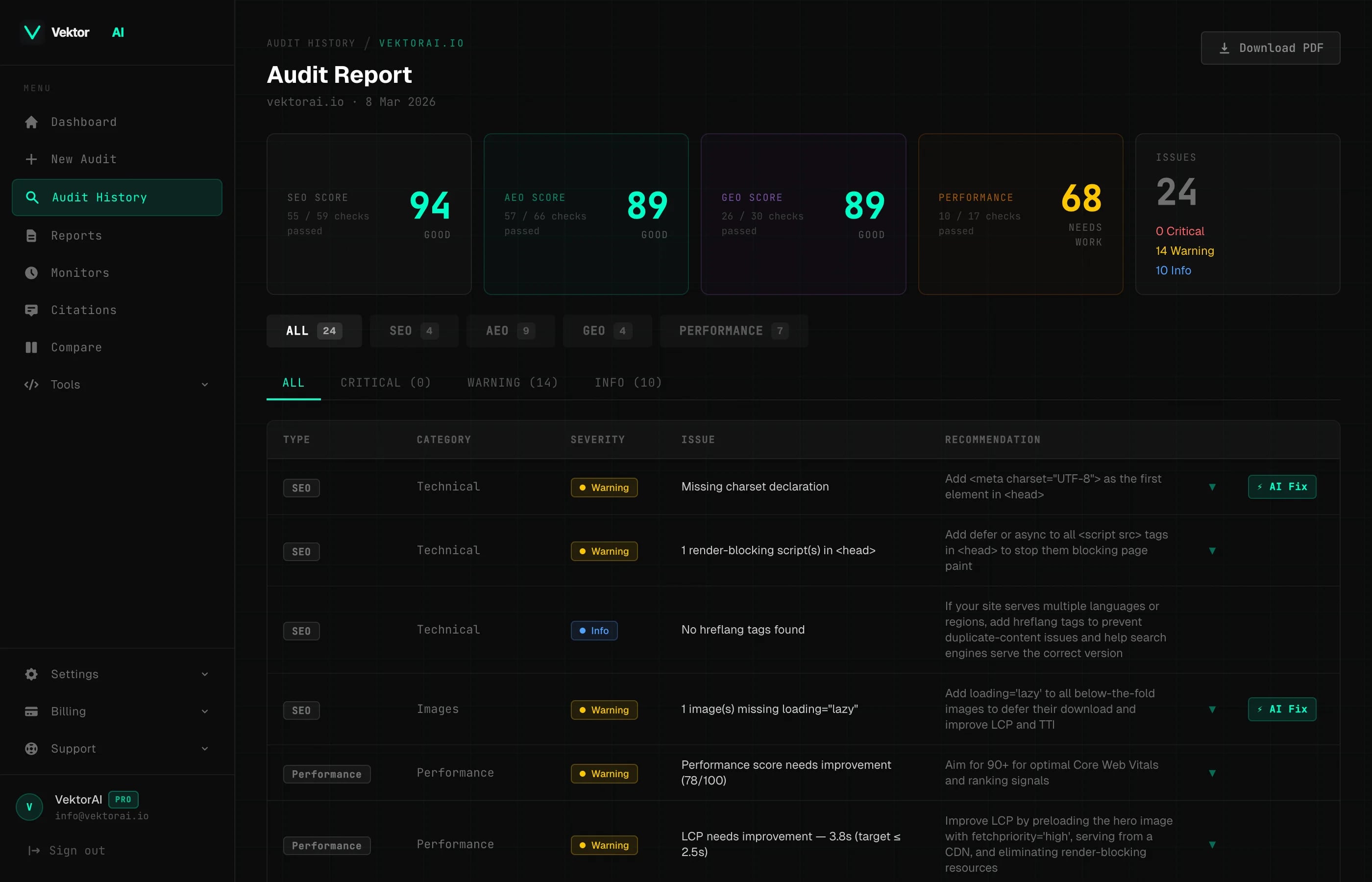
VektorAI audits all GEO signals — content depth, quotability, E-E-A-T trust, citation depth, and query alignment — alongside SEO, AEO, and Performance checks. Paste any public URL and receive a scored GEO report with issue-by-issue breakdowns and actionable fixes in under 30 seconds. No account needed.
Run a Free GEO Audit →Frequently Asked Questions About GEO
What does GEO stand for?▸
What is the difference between AEO and GEO?▸
What are the five pillars of GEO?▸
How long should my content be for good GEO?▸
What makes content quotable for AI engines?▸
How can I check my GEO score for free?▸
Ready to Get Cited by AI Engines?
Run a free audit to see exactly where your GEO signals stand. Then explore Answer Engine Optimization (AEO) to ensure your metadata layer is also covered — because getting cited starts with getting indexed.