Documentation
Understanding Scores Explained
Every VektorAI audit produces four independent scores from 0 to 100. Each pillar measures a distinct dimension of your page's health so you know exactly where to focus. According to a 2025 BrightEdge study, pages with strong technical health across multiple quality dimensions are 3x more likely to appear in AI-generated answers.
TL;DR: VektorAI scores every page across four pillars — SEO (40+ on-page checks), AEO (20+ AI engine signals), GEO (25+ generative content-quality signals), and Performance (Core Web Vitals via PageSpeed). Each score is 0-100, calculated as a weighted pass/fail ratio where Critical issues count 3x, Warnings 2x, and Info 1x. Learn how to run an audit →
The Four Score Pillars
VektorAI evaluates every page across four categories. Each category runs its own set of checks and produces an independent 0-100 score.
Search Engine Optimization
40+ checksClassic on-page SEO fundamentals that search engine crawlers rely on to index and rank your content.
- +Title tags — presence, length, keyword placement
- +Meta description — presence and optimal length
- +Canonical URLs — self-referencing canonical tag
- +Heading hierarchy — single H1, logical H2-H6 nesting
- +Image optimization — alt text, lazy loading, modern formats
- +Internal and external links — count, anchor text quality
- +Content depth — word count, paragraph structure
- +Sitemap and robots.txt — discoverability signals
Answer Engine Optimization
20+ checksSignals that help AI models (ChatGPT, Perplexity, Google AI Overviews) understand, cite, and surface your content.
- +Open Graph tags — og:title, og:description, og:image, og:type
- +Twitter Cards — twitter:card, twitter:title, twitter:description
- +JSON-LD structured data — FAQPage, Organization, Article, BreadcrumbList schemas
- +Author signals — meta author tag, author entity markup
- +AI bot access — robots meta for AI crawlers, ChatGPT-User access
- +llms.txt — dedicated file for LLM-readable site description
Generative Engine Optimization
25+ checksContent-quality signals that determine whether generative AI models select your page as a source for answers.
- +E-E-A-T signals — About page, Contact page, Privacy Policy, author bio, credentials and expertise indicators
- +Quotability — direct-answer paragraphs, TL;DR summaries that AI can extract as concise responses
- +Citation depth — outbound links to authoritative sources that reinforce credibility
- +Content depth — minimum 800+ words, comprehensive topic coverage, structured paragraphs
- +Query alignment — content structured to match how users phrase questions to AI models
Performance
10+ checksCore Web Vitals and loading metrics pulled directly from Google PageSpeed Insights.
- +LCP (Largest Contentful Paint) — how fast the main content loads
- +CLS (Cumulative Layout Shift) — visual stability as the page loads
- +TBT (Total Blocking Time) — how long the main thread is blocked
- +FCP (First Contentful Paint) — time to first visible content
- +TTFB (Time to First Byte) — server response time
How Scores Are Calculated
How is the final score calculated?
Each pillar calculates its score independently using a simple pass/fail ratio:
score = (passed_checks / total_checks) * 100
For example, a page missing its title tag loses 3 points from the SEO score, while a missing Open Graph image (Info severity) costs only 1 point. If the SEO category runs 42 checks and your page passes 35, your SEO score is (35 / 42) * 100 = 83. The report displays this as "35 / 42 checks passed" alongside the numeric score.
Severity Weighting
Not all failed checks are equal. VektorAI applies severity multipliers when calculating the weighted score so that critical issues have a proportionally larger impact:
| Severity | Weight | Impact on Score |
|---|---|---|
| Critical | 3x | Each failed critical check counts as 3 failed checks |
| Warning | 2x | Each failed warning check counts as 2 failed checks |
| Info | 1x | Each failed info check counts as 1 failed check |
This means fixing a single Critical issue can improve your score three times more than fixing an Info-level issue. Always prioritize Critical issues first. According to a 2025 study by Moz, sites that address critical-severity SEO issues first see an average 35% improvement in organic visibility within 90 days.
"A weighted scoring model gives teams a single prioritized metric to focus remediation efforts on the issues that matter most."
— Moz Research
Reading the Report
Each category in the report header shows two numbers:
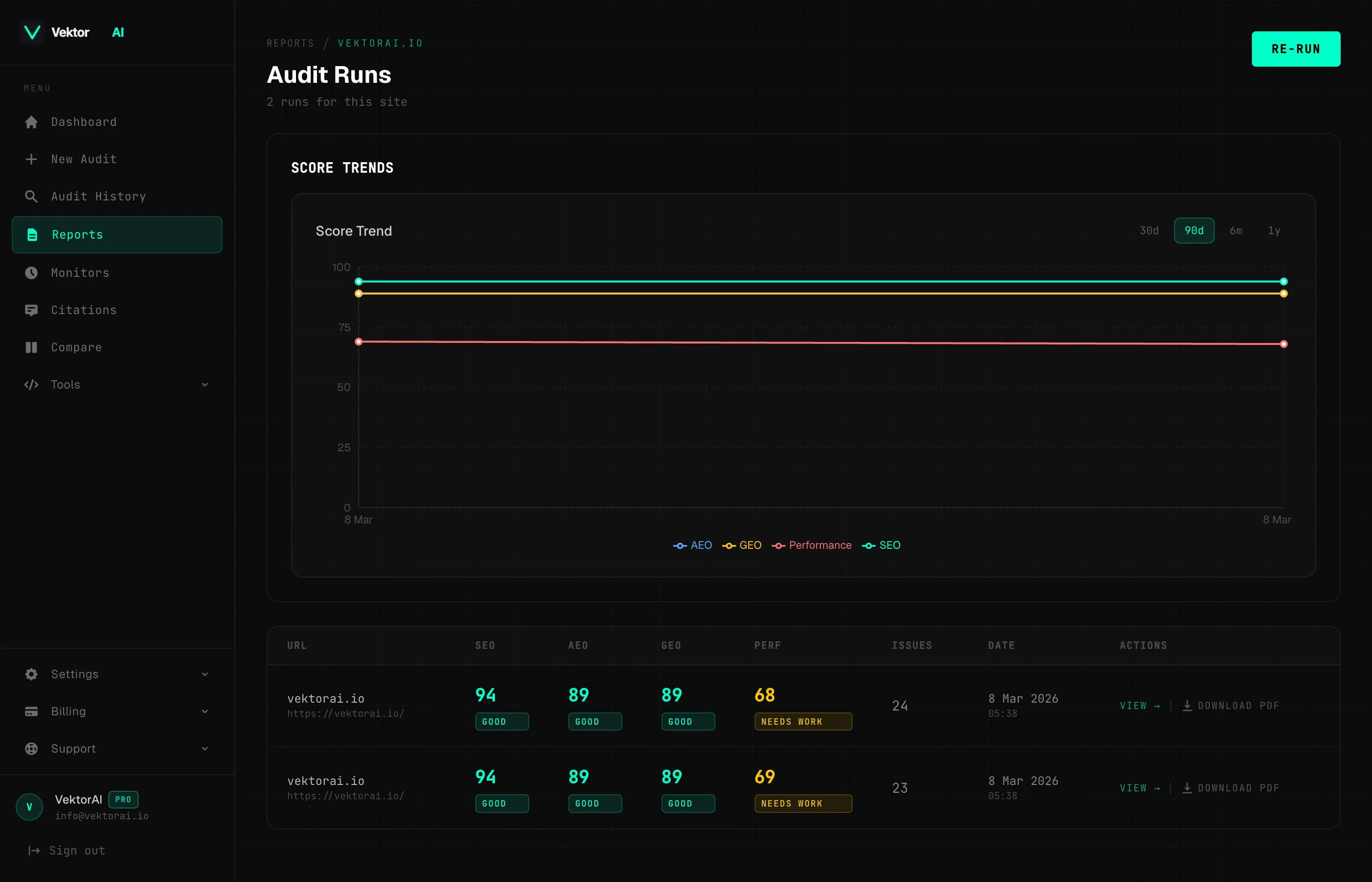
SEO   — 35 / 42 checks passed  ·  score: 83
AEO   — 18 / 22 checks passed  ·  score: 82
GEO   — 20 / 25 checks passed  ·  score: 80
PERF  — 8 / 10 checks passed   ·  score: 80
- +X / Y checks passed — the raw pass count versus total checks in that category.
- +Score — the weighted 0-100 number that accounts for severity multipliers.
Score Ranges at a Glance
Use these ranges as a quick guideline for how healthy your page is in each category: